Dating again? What older adults should know about sexual health and protection
Age does not make you immune to sexually transmitted diseases. Here’s what you need to know.
(Aging Untold) — Dating, intimacy and connection can be an important part of emotional and physical well-being for older adults. That includes people who are divorced, widowed, remarried or dating again for the first time in decades.
The Aging Untold experts are addressing the topics of sexual health, how it has changed over the years and how to stay protected.
You can’t tell by looking
Dr. Rhea Rogers, a board-certified physician, said appearances do not show whether someone has a sexually transmitted disease.
“You can’t tell by looking at someone if they have a sexually transmitted disease,” Rogers said. “You say, ‘Oh, they look healthy.’ You can’t tell by that.”
She said age does not change that risk.
“Getting older does not make you immune to getting a sexually transmitted disease,” Rogers said. “Just because you retired, your sexual health didn’t.”
Rogers said older adults have to take precautions to protect themselves against several diseases.
Condoms are about more than preventing pregnancy.
Over the decades, prevention options have changed, including for HIV.
And human papillomavirus, or HPV, is the most common sexually transmitted disease, Rogers said. The virus can cause cancer later in life, according to the Centers for Disease Control and Prevention.
Menopause is not protection
Having gone through menopause does not mean you do not need protection, the Aging Untold experts said.
“A lot of people think, ‘Well, I’ve been through menopause, I can’t get pregnant. I don’t need to protect myself,’” gerontologist Sam Cradduck said. “Menopause doesn’t protect you from gonorrhea or syphilis or HIV or HPV.”
Cradduck also said syphilis contracted at a younger age can show up later in life, and it shows up in communities where older adults live.
“That lives forever in you,” Cradduck said. “We’ve seen neurosyphilis in communities.”
Start the conversation
Aging expert Amy O’Rourke said prevention starts with getting tested and having a conversation with your partner.
It can be awkward to ask a new partner whether they have been tested, especially for people who were married for many years before dating again, but the conversation still matters, she said.
One approach is to start by saying that an active sex life is important to you, then ask how the other person feels about getting tested and what the two of you will do to prevent infection, O’Rourke said.
Talk to your doctor as well, get tested and know what your risk factors are because you might have some and not know it, Rogers added. And protect yourself.
“That test might have been one month ago and things have changed,” Rogers said.
One of the risk factors that Rogers noted is a weakened immune system.
“If your immune system is not strong, you can’t fight off what you get exposed to,” Rogers said.
Protection details that matter
Cradduck added that people should check to see if the products they plan to use can be used together.
“Wearing a condom is important, but a lot of condoms and a lot of lubricants don’t go well together, and so you will impair the integrity of the condom with certain lubricants,” she said.
She also said people with a latex allergy should not use a latex condom.
Rogers said that it is easy for someone who has one disease to get another.
“When we treat people for chlamydia or gonorrhea, we treat for the other one as well,” Rogers said.
She added that PrEP, pre-exposure prophylaxis, a medication taken to prevent HIV infection, does not provide protection against other sexually transmitted diseases.
Couples who are dating after being widowed, each with one sexual partner, should still use protection, Rogers said.
“They only had one sexual partner that they know about,” Rogers said. “I used to get this all the time. ... You only know what the person told you. You don’t really know, so still protect yourself.”
Rogers said people should talk to their health care provider, talk to their partner and know whether they have risk factors that put them at risk for other things.
Name the diseases
To address the topic of sexually transmitted diseases, O’Rourke said she thinks it helps to name specific diseases instead of using the term “STDs.”
“STD seems like a distancer, like you don’t really hear syphilis. When I hear syphilis, my ears perk up. I think it’s important to really say what those diseases are, and then what do we get if we have it and it progresses and you’re older? I want to say the word cancer,” O’Rourke said.
Key takeaways
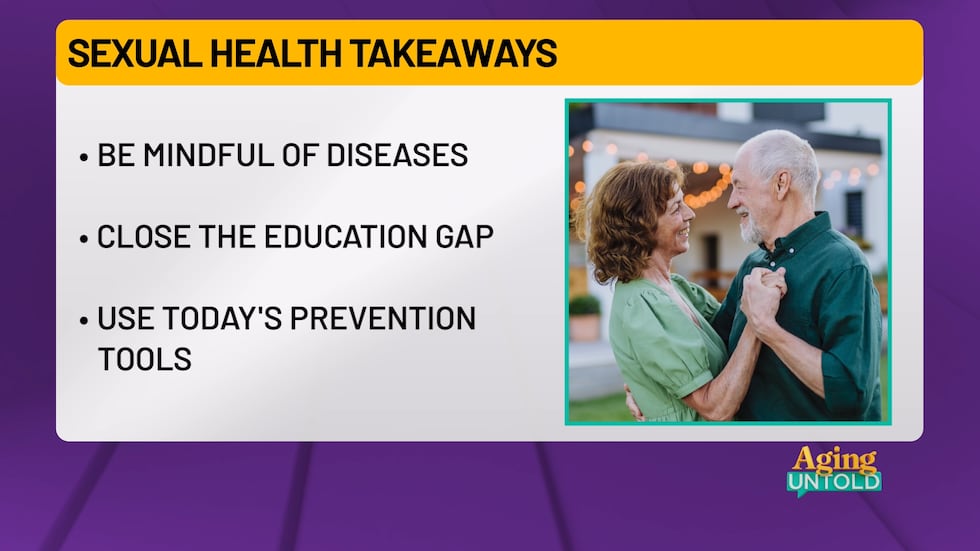
Be mindful of diseases, including gonorrhea and syphilis
Close the education gap: The three Ps are partners, practices and protection
Use today’s prevention tools, such as advanced screenings, immune supports and daily PrEP
This program is provided for educational and informational purposes only and does not constitute providing medical advice or professional services. The information provided should not be used for diagnosing or treating a health problem or disease, and those seeking personal medical advice should consult with a licensed physician. Always seek the advice of your doctor or other qualified health provider regarding a medical condition. Never disregard professional medical advice or delay in seeking it because of something you have seen on this program. If you think you may have a medical emergency, call 911 or go to the nearest emergency room immediately. No physician-patient relationship is created by this program or its use. Aging Untold/Gray Media, nor its employees, contractors or agents, nor any contributor to this program, makes any representations, express or implied, with respect to the information provided herein or to its use.
Copyright 2026 Gray Media Group, Inc. All Rights Reserved.